Driving Guide
How to Get a UK Driving Licence: A Step-by-Step Guide
Learn how to get a UK driving licence, from applying for a provisional licence and choosing lessons to passing the theory and practical driving tests.
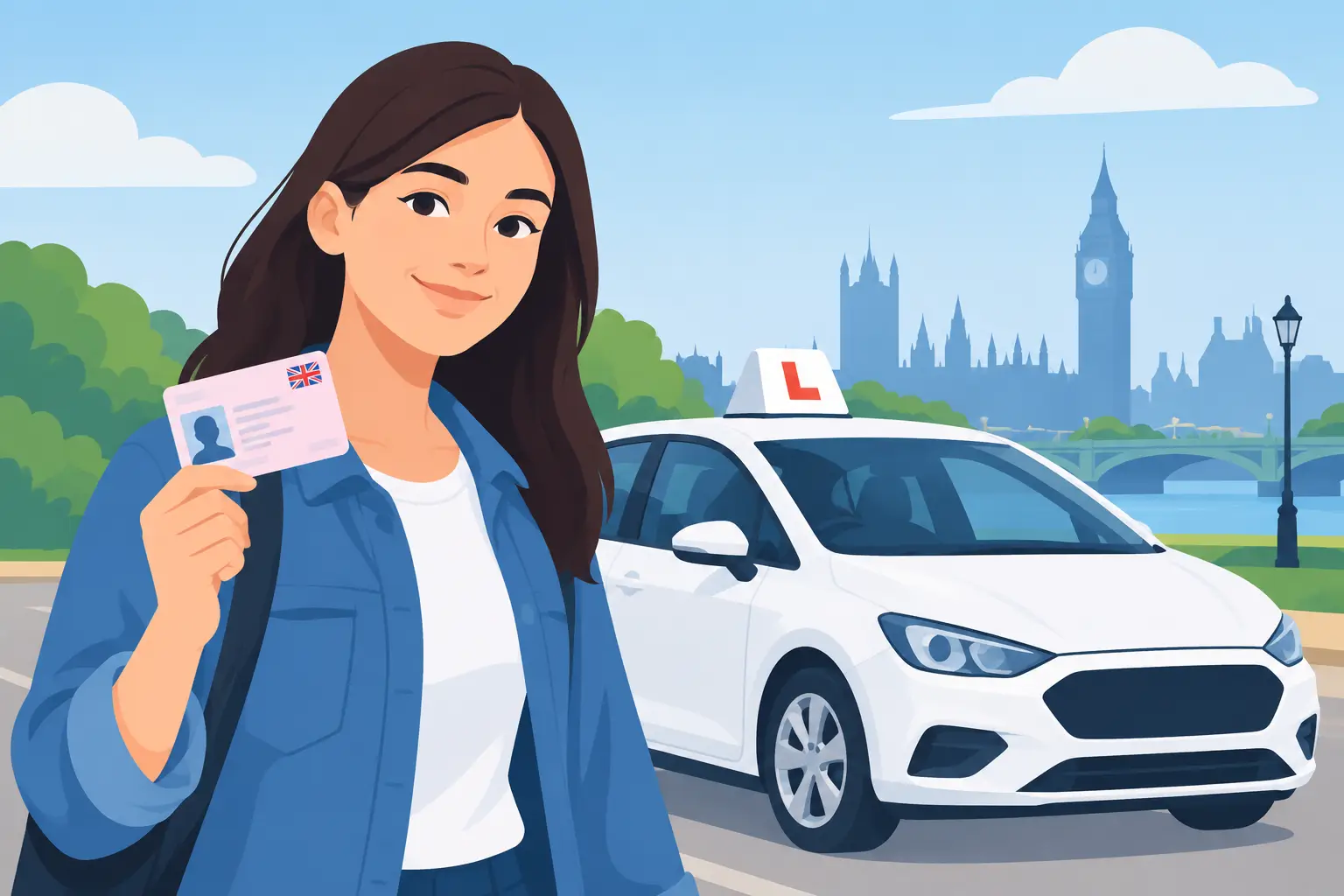
How to Get a UK Driving Licence: A Step-by-Step Guide
Getting a UK driving licence starts before you sit behind the wheel.
For most new drivers, the journey involves getting a provisional licence, choosing between manual and automatic lessons, building your skills through professional tuition and practice, passing the theory test and then taking the practical driving test.
Knowing what comes next can make the process feel much more manageable.
For learners in Luton, Bedford, Watford and surrounding areas, your choice of instructor, lesson availability and test preparation can also affect how smoothly the journey progresses.
The important thing is not to rush through the stages.
Build the skills you need, understand the requirements and take each test when you are properly prepared.
1. Apply for a provisional driving licence
You can apply for a provisional driving licence from 15 years and 9 months old.
You can normally start driving a car on public roads from the age of 17.
There are different rules for some people with disabilities or long-term health conditions.
You need a provisional licence before you can take driving lessons or practise driving a car.
Before applying, make sure you meet the relevant eyesight requirements. You must be able to read a vehicle number plate from the required distance, with glasses or contact lenses if you need them.
You will also need to provide the information required for your application, including identity and address details.
Once your provisional licence arrives, keep it safe.
You will need the relevant licence details when booking your theory and practical tests.
Can you practise before taking lessons?
Yes.
You can learn with a qualified driving instructor or practise with an eligible family member or friend.
If you practise privately, the person supervising you must:
- Be at least 21.
- Have held a full driving licence for at least three years.
- Be qualified to drive the type of vehicle you are learning in.
For example, someone supervising a learner in a manual car must hold a licence that allows them to drive a manual car.
The vehicle must also be appropriately insured for you to drive as a learner and display the required L plates.
Other legal requirements also apply to the vehicle and the circumstances in which you practise.
If you are unsure about private practice, check the current GOV.UK guidance before driving.
2. Choose between manual and automatic lessons
One of the most important decisions is whether to learn in a manual or automatic car.
There is no single option that is right for everyone.
Your choice can depend on:
- The type of cars you expect to drive.
- Your confidence.
- Your budget.
- Your learning preferences.
- Whether you may use a family car.
- Your future driving plans.
With a manual licence, you can generally drive both manual and automatic cars.
Learning manual means developing clutch and gear control alongside steering, observations, positioning and planning.
Some learners prefer this because it gives them access to a wider range of vehicles.
With an automatic-only licence, you are restricted to automatic vehicles.
Automatic tuition can appeal to learners who find clutch control and gear changes distracting or who want to concentrate more on road awareness and decision-making.
Automatic vehicles are also increasingly common, including electric vehicles.
The important thing is to choose the transmission that suits your circumstances rather than assuming one is automatically better.
Read our guide to automatic vs manual driving lessons before making your decision.
Can you change from automatic to manual later?
Yes.
If you pass your driving test in an automatic car and later decide that you want to drive manual cars, you can take a practical test in a manual car to upgrade your licence.
You do not need to take the car theory test again simply because you are upgrading from automatic to manual.
That means choosing automatic does not necessarily prevent you from learning manual later.
However, changing transmission later involves additional lessons, preparation and a practical test, so it is worth considering your longer-term needs before choosing.
3. Find the right driving instructor
Your instructor can have a major influence on how you learn.
Look for someone whose:
- Professional status is clear.
- Transmission matches your needs.
- Availability fits your routine.
- Teaching style suits the way you learn.
- Lesson terms are clear.
- Feedback helps you understand what to improve.
You should also be able to ask questions without feeling uncomfortable.
A good lesson is not simply time spent driving.
You should gradually understand what you are learning, why you are learning it and what you need to improve next.
If you are comparing instructors, read our guide on how to choose a driving instructor.
You can also learn how to check a driving instructor's licence and how to verify an instructor before booking.
4. Start building your driving skills
There is no fixed number of professional lessons you must complete before taking your practical test.
Different learners need different amounts of training and practice.
Your experience can depend on:
- Previous driving experience.
- How regularly you practise.
- How quickly you develop vehicle control.
- Your confidence.
- The amount of private practice available.
- How easily you adapt to different road environments.
Early lessons may focus on:
- Vehicle controls.
- Moving off and stopping.
- Steering.
- Mirror use.
- Speed control.
- Basic junctions.
As your skills develop, lessons can progress towards:
- Crossroads.
- Roundabouts.
- Meeting traffic.
- Pedestrian crossings.
- Different speed limits.
- Dual carriageways.
- Country roads.
- Manoeuvres.
- Independent driving.
- More complex traffic conditions.
The aim is not to memorise a particular route.
You need to become capable of reading the road and making safe decisions wherever you drive.
Our guide to how many driving lessons you need explains why there is no universal number that guarantees test readiness.
5. Practise between professional lessons where possible
Professional lessons are important, but suitable private practice can give you additional time behind the wheel.
If you practise with family or friends, make sure the supervision, insurance and vehicle arrangements meet the legal requirements.
Use private practice with a purpose.
For example, after learning junction routines with your instructor, you could reinforce those skills during suitable supervised journeys.
You might practise:
- Smooth stopping.
- Moving off.
- Reading road signs.
- Junction observations.
- Meeting traffic.
- Appropriate speed control.
- General road awareness.
Avoid using private practice to rush into situations that are beyond your current ability.
The goal is to reinforce good habits rather than introduce unnecessary pressure.
6. Develop hazard perception
Hazard perception is one of the foundations of safe driving.
You need to notice situations that may require you to change speed or direction before they become urgent.
Look beyond the vehicle immediately ahead.
You might notice:
- Brake lights several vehicles ahead.
- A pedestrian approaching a crossing.
- A cyclist moving around a parked vehicle.
- A car waiting at a side road.
- Children near the road.
- A bus stopping.
- Traffic beginning to slow.
- A vehicle emerging from a driveway.
The earlier you recognise a developing situation, the more time you generally have to respond.
This is useful for everyday driving as well as the theory test.
Our guide to driving hazard perception explains how to develop the skill.
7. Pass the car theory test
You need to pass the car theory test before you can book your practical driving test.
The theory test has two parts:
- Multiple-choice questions.
- Hazard perception.
You take both parts as one test and must pass both to pass the theory test. :contentReference[oaicite:1]{index=1}
The multiple-choice section tests knowledge of areas such as:
- Road rules.
- Traffic signs.
- Safe driving.
- Vulnerable road users.
- Vehicle safety.
The hazard perception section uses video clips to test how well you recognise developing hazards.
When should you start revising?
Do not wait until the last few days.
Short, regular revision sessions can help you build your knowledge without trying to learn everything at once.
Use current revision material and practise the hazard-perception format so that you understand how the test works.
Most importantly, try to understand the reasons behind the answers.
Knowing a rule for the test is useful.
Understanding how that rule affects your real driving is even more valuable.
How long does the theory test pass last?
Your theory-test pass certificate is valid for two years.
You must pass your practical driving test within that period.
If it expires before you pass the practical test, you will need to pass the theory test again. :contentReference[oaicite:2]{index=2}
8. Book your practical driving test when you are ready
You must pass your theory test before booking the practical car driving test.
There is no minimum number of lessons you must complete before taking the test.
Instead, you should be able to drive safely in different road and traffic conditions and demonstrate the required skills without instruction. :contentReference[oaicite:3]{index=3}
Your instructor can help you judge whether you are approaching the required standard.
Before booking, consider whether you can:
- Drive without constant prompts.
- Deal with unfamiliar roads.
- Recognise developing hazards.
- Make appropriate decisions at junctions.
- Handle roundabouts.
- Maintain suitable speed and positioning.
- Follow independent-driving directions.
- Complete the required manoeuvres.
- Recover safely from mistakes.
Being nervous does not necessarily mean you are not ready.
Likewise, feeling confident does not automatically mean your driving is test standard.
Look at the consistency of your driving.
9. Understand the 2026 driving-test booking rules
There are important changes to car driving-test bookings in 2026.
You must book your own car driving test.
Since 12 May 2026, driving instructors and third-party services cannot book or manage a car driving test on your behalf. :contentReference[oaicite:4]{index=4}
There is also a limit of two changes to an existing car driving-test booking.
Since 9 June 2026, when you move a test, there are also restrictions on which test centres you can move it to. :contentReference[oaicite:5]{index=5}
This makes it particularly important to discuss your likely readiness with your instructor before booking.
Your instructor can help you decide when you are likely to be ready and can provide their instructor reference number for your booking.
But the booking itself must be made and managed by you.
Be careful with unofficial test-booking services
DVSA has also introduced restrictions around unofficial services that scan the booking system for available appointments.
Do not assume that a website or app offering to find or manage test appointments is authorised simply because it appears professional.
Use GOV.UK to book and manage your test.
10. Prepare for the practical driving test
The practical test assesses whether you can drive safely and independently.
It includes:
- An eyesight check.
- Vehicle-safety questions.
- General driving.
- Independent driving.
- One reversing exercise.
- Potentially an emergency stop.
The reversing exercise can involve:
- Parallel parking.
- Bay parking.
- Pulling up on the right and reversing.
You do not need to perform every part perfectly.
However, you need to demonstrate safe control, observation and decision-making.
During independent driving, you may be asked to follow a sat nav, traffic signs or a combination of both.
If you make a wrong turn, do not panic.
A wrong direction is not automatically a failure.
The important thing is to continue safely rather than making a sudden or dangerous correction.
Our guide to preparing for your DVSA driving test covers test-day preparation in more detail.
11. Do not rely on memorising test routes
If you are taking your test in Luton, you may be tempted to search for Luton test routes and memorise every possible turn.
Local practice is useful.
Route memorisation is not the objective.
Your examiner may take you along roads you have not previously driven.
Roadworks, traffic and other conditions can also change.
Instead, practise the underlying skills:
- Reading signs.
- Choosing lanes.
- Managing speed.
- Observing at junctions.
- Handling roundabouts.
- Meeting traffic.
- Following sat-nav directions.
- Responding to unfamiliar situations.
Our Luton driving test routes guide explains how to use local knowledge without becoming dependent on a memorised route.
12. Keep practising as your test approaches
The final weeks before your test should be focused on consistency.
Your instructor can help identify patterns such as:
- Approaching junctions too quickly.
- Missing mirror checks.
- Hesitating unnecessarily.
- Choosing lanes too late.
- Struggling with independent directions.
- Losing concentration in busy traffic.
- Needing prompts during manoeuvres.
Work on the underlying problem rather than simply repeating the same route.
A mock test can also be useful.
It gives you an opportunity to experience a longer period of driving with less instructor support and can highlight areas that still need attention.
But do not turn every lesson into a mock test.
If a mock test reveals that your junction observations need improvement, spend time developing those observations.
13. Keep track of your progress
Learning to drive can feel frustrating when you focus only on what you cannot yet do.
Progress tracking gives you a more balanced view.
You might track skills such as:
- Vehicle control.
- Observations.
- Junctions.
- Roundabouts.
- Speed management.
- Positioning.
- Manoeuvres.
- Independent driving.
- Hazard perception.
- Test readiness.
A skill does not necessarily become "finished" after one successful lesson.
The aim is to become increasingly consistent and independent.
Our driving lesson progress tracker explains how this can work.
14. What happens when you pass?
Once you pass your practical driving test, you can start driving on your own as long as you have appropriate insurance.
If you passed using your provisional photocard licence, the examiner will normally arrange for your full licence to be issued.
Your learning does not stop at the test.
You have demonstrated the standard required to drive independently, but you will still be gaining experience.
New drivers need particular care during the early period of independent driving.
Consider starting with journeys that allow you to build experience gradually.
You might begin with familiar routes before progressively taking on:
- Unfamiliar areas.
- Longer journeys.
- Night driving.
- Different weather.
- Busier traffic.
- Faster roads.
Do not let passing the test create pressure to immediately drive everywhere.
Experience develops over time.
15. Understand the New Drivers Act
The first two years after passing are particularly important.
Under the New Drivers Act, your licence can be revoked if you accumulate 6 or more penalty points within two years of passing your first driving test. :contentReference[oaicite:6]{index=6}
Penalty points already on your provisional licence can also carry over to your full licence.
If your licence is revoked under these rules, you will need to apply for a new provisional licence and pass both the theory and practical tests again before getting your full licence back. :contentReference[oaicite:7]{index=7}
That is one reason why good habits should continue after the test.
Passing is the beginning of independent driving, not the end of learning.
16. Consider further training after passing
Some new drivers benefit from additional training after passing.
This might include further practice in areas where they have limited experience or a recognised course such as Pass Plus.
You do not need to treat passing your test as proof that there is nothing left to learn.
You may still want to improve your:
- Motorway confidence.
- Night driving.
- Rural-road driving.
- Long-distance driving.
- Parking.
- Driving in unfamiliar towns.
- Hazard awareness.
Experience combined with sensible practice can help you become more comfortable and capable.
Getting a UK driving licence: the journey in simple steps
For most car learners, the journey looks like this:
1. Apply for a provisional licence
Get the legal permission to learn.
2. Choose manual or automatic
Consider your current needs and future driving plans.
3. Find a suitable instructor
Choose someone whose teaching style, availability and vehicle match your requirements.
4. Start professional lessons
Build your vehicle control, observations and road awareness.
5. Practise appropriately
Use suitable private practice where the legal requirements are met.
6. Study for the theory test
Learn the Highway Code and develop hazard-perception awareness.
7. Pass the theory test
You must pass both the multiple-choice and hazard-perception parts.
8. Continue developing practical skills
Work towards independent driving across different road and traffic conditions.
9. Book your practical test yourself
Discuss your readiness with your instructor, then use the official GOV.UK service to book.
10. Prepare for test day
Practise the skills you still need to make consistent.
11. Pass and continue learning
Build experience gradually as a newly qualified driver.
How Real Drive can support your driving journey
Getting a driving licence involves more than passing two tests.
You need to find suitable tuition, organise lessons, develop individual skills and know when you are genuinely ready for the practical test.
Real Drive is designed to make that journey easier to manage.
Learners can find verified instructors, compare lesson information, organise bookings and keep track of their progress.
For learners looking for driving lessons in Luton, having your instructor, lesson schedule and learning progress organised can make it easier to concentrate on the most important part: becoming a safe and independent driver.
Your driving licence is only the beginning
Getting a UK driving licence can seem like a long process when you are looking at it for the first time.
But each stage has a purpose.
Your provisional licence gives you permission to learn.
Professional lessons build your practical skills.
Private practice can reinforce those skills where it is legal and appropriate.
The theory test checks your knowledge and hazard awareness.
The practical test assesses whether you can apply your skills safely and independently.
And passing the test gives you the opportunity to continue developing through real-world driving experience.
You do not need to rush through the process.
Choose the right instructor, practise consistently, understand what you need to improve and book your test when your driving is ready.
The goal is not simply to hold a driving licence.
It is to become a driver who can use it safely and confidently.
Keep learning