Driving Guide
9 Ways to Build Driving Confidence as a Learner
Discover practical ways to build driving confidence, including structured lessons, regular practice, handling mistakes, managing nerves and becoming more independent behind the wheel.
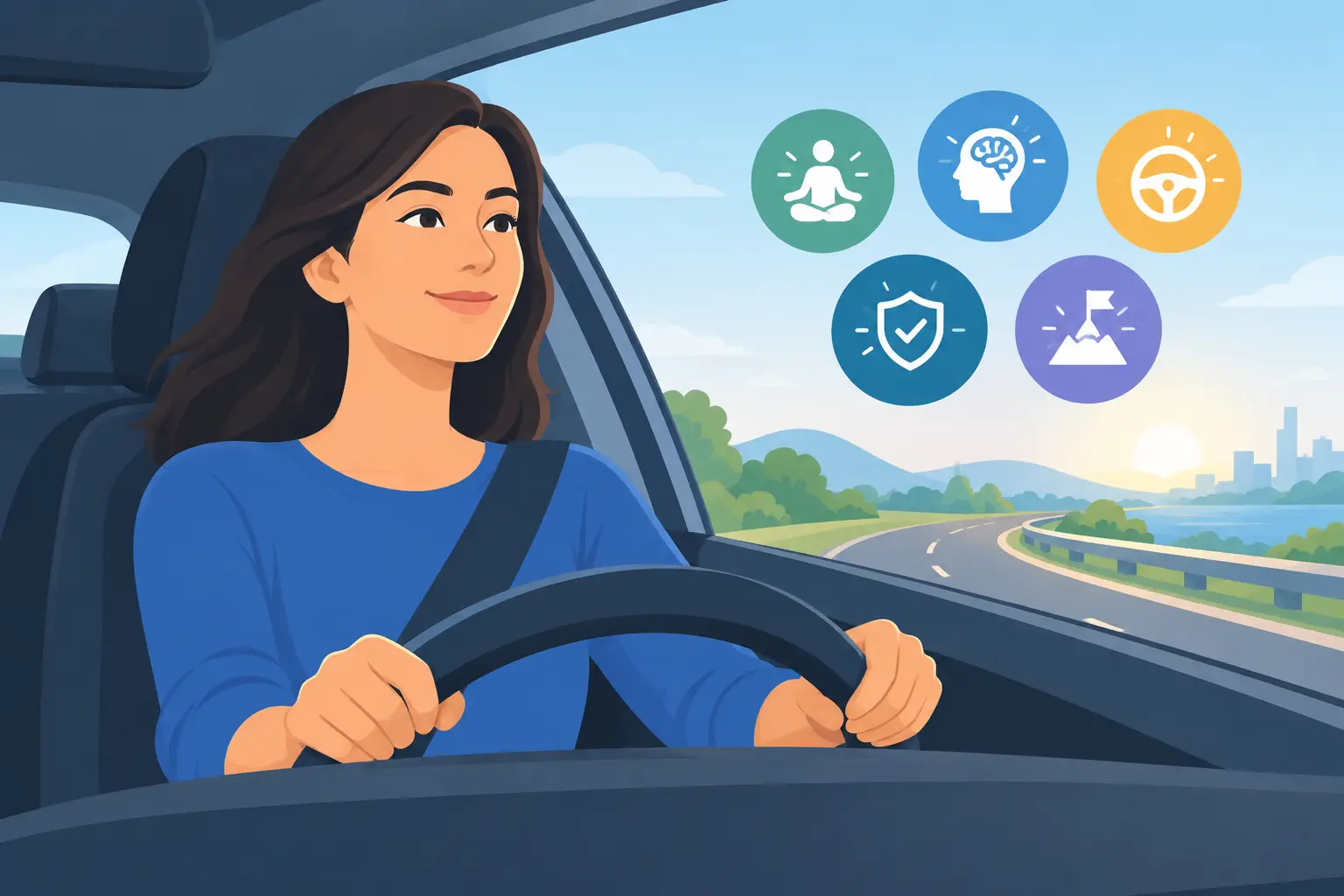
Your first busy roundabout can make everything you learned five minutes earlier seem to disappear.
The pedals suddenly feel unfamiliar, there are several mirrors to think about and every other vehicle appears to be moving faster than expected.
Feeling like this does not mean you cannot learn to drive.
Building driving confidence is not about forcing yourself to feel fearless. It comes from developing the skills, judgement and experience that allow you to make safe decisions even when a situation feels challenging.
Every time you deal with a junction safely, recover calmly from a stall or recognise a hazard without being prompted, you gain evidence that you can manage more of the driving yourself.
Here are nine practical ways to build driving confidence while learning.
1. Learn with a plan, not just a lesson diary
Driving confidence can be harder to develop when every lesson feels disconnected from the previous one.
You might practise manoeuvres during one lesson, spend the next few sessions on completely different roads and then struggle to remember how the original skill worked.
A structured learning plan gives your lessons some direction.
You do not need to know exactly what you will be doing several months from now, but you should have a reasonable understanding of:
- What you are currently learning.
- Which skills are becoming more independent.
- What still needs practice.
- What your instructor wants to introduce next.
For a new learner, early lessons may include vehicle controls, moving off, stopping, steering and basic observations.
As those skills develop, your lessons can introduce situations such as:
- Junctions.
- Meeting and passing traffic.
- Roundabouts.
- Different speed environments.
- Parking and reversing exercises.
- Faster roads where appropriate.
- Independent driving.
The exact order will depend on your experience, ability and local road environment.
What matters is that the learning progresses for a reason rather than becoming a collection of unrelated drives.
Our driving tuition guide explains how structured lessons can help you develop towards independent driving.
2. Choose an instructor you can communicate with
The relationship you have with your instructor can have a significant effect on your confidence.
You should feel able to say:
"I don't understand that."
or:
"Can we go through that again?"
or:
"That situation made me nervous."
You are learning.
You are not expected to arrive already knowing how to drive.
Different learners also respond to different teaching approaches.
Some prefer a detailed explanation before attempting something.
Others understand more effectively by trying the skill and then discussing what happened.
You may prefer plenty of questions and coaching, or you may find too much information at once distracting.
The important thing is being able to communicate with your instructor about what is helping you learn.
When choosing an instructor, consider:
- Their professional status.
- Manual or automatic tuition.
- Availability.
- Teaching area.
- Lesson options.
- Communication.
- Teaching approach.
- Cancellation and rescheduling terms.
- How progress is reviewed.
Our guide to how to choose a driving instructor looks at these factors in more detail.
You can also learn how to verify a driving instructor before booking.
3. Break difficult driving situations into smaller skills
Many driving worries sound enormous when you describe them as one problem.
You might think:
"I can't do roundabouts."
But a roundabout is not one skill.
It involves several smaller decisions.
You need to:
- Recognise the roundabout.
- Read signs and road markings.
- Check mirrors appropriately.
- Choose an appropriate lane.
- Adjust your speed.
- Observe traffic.
- Decide when it is safe to proceed.
- Maintain suitable positioning.
- Continue observing as you leave.
Your difficulty may involve only one or two parts of that process.
Perhaps you recognise the lane markings too late.
Perhaps your approach speed leaves you with too little time to observe.
Perhaps your vehicle control is fine, but you struggle to judge an appropriate opportunity to proceed.
Identifying the actual problem makes practice much more useful.
Instead of repeatedly thinking:
"I need to get better at roundabouts."
you can work on something specific:
"I need to recognise the signs earlier so I have more time to choose my lane."
That is a skill you can practise.
4. Understand what the car is doing instead of memorising routines
Confidence improves when you understand why something works.
This is particularly important with manoeuvres.
When learning bay parking, for example, your instructor may give you useful reference points for the vehicle you are driving.
Those can help while you develop the skill.
But the objective should not be to memorise a sequence without understanding it.
Learn:
- Why you start from a particular position.
- How steering changes the path of the vehicle.
- How the front and rear of the car move.
- What you should see as the vehicle enters the space.
- How to recognise when the position is incorrect.
- How to make an appropriate correction.
Then, if the starting position changes slightly or you eventually drive another vehicle, you have more than a memorised formula to rely on.
The same principle applies throughout driving.
Understanding the reason behind an action makes it easier to use that knowledge somewhere unfamiliar.
Our guide to mastering bay parking explains this approach in more detail.
5. Practise regularly enough to keep developing
There is no single lesson schedule that is right for every learner.
Your ideal pattern can depend on:
- Your budget.
- Your availability.
- Your concentration.
- Your previous experience.
- Your progress.
- Opportunities for suitable private practice.
Some learners prefer regular weekly tuition.
Others have lessons closer together.
Some need a different schedule because of work, college or family commitments.
The important question is whether your schedule allows you to continue building on what you have learned.
Very long gaps can sometimes make recently developed skills feel less familiar, particularly during the earlier stages of learning.
But simply booking as many hours as possible does not guarantee faster progress either.
Learning still requires concentration and useful practice.
A longer lesson may be valuable when you need enough time to experience different roads or travel to a particular area.
On another occasion, a different lesson duration may work better.
Discuss the options with your instructor rather than assuming there is one ideal lesson length or frequency for everybody.
If you are deciding between concentrated tuition and a regular schedule, see our comparison of intensive vs weekly driving lessons.
6. Use private practice with a purpose
Where the learner, supervising driver, insurance and vehicle meet the applicable legal requirements, private practice can provide useful additional experience.
But simply spending more time in a car does not automatically mean every minute is equally useful.
Give the drive a purpose.
You might decide to concentrate on:
- Smooth braking.
- Moving off.
- Junction approaches.
- Meeting traffic.
- Reading road signs.
- Maintaining an appropriate position.
- General observations.
If possible, discuss suitable practice with your instructor.
That helps reinforce what you are learning professionally rather than introducing unnecessary confusion.
Private practice should also remain appropriate to your current ability.
You do not need to prove your confidence by immediately tackling the most difficult roads available.
Build experience progressively.
If you are unsure about the legal requirements for private practice, our guide to whether a learner driver can drive alone explains the supervision and insurance requirements in more detail.
7. Learn something specific from mistakes
Stalling at traffic lights can feel embarrassing.
Choosing the wrong lane can make you question whether you were paying attention.
Missing a turn can make an otherwise good lesson feel unsuccessful.
But mistakes are expected while learning.
What matters is what you learn from them.
Avoid vague conclusions such as:
"I'm terrible at driving."
Instead ask:
What actually happened?
What information did I miss?
Which action happened too late?
What could I do differently next time?
Perhaps you approached a junction too quickly and therefore had less time to observe.
Perhaps you noticed a lane sign late because your attention was too close to the vehicle ahead.
Perhaps you stalled because your clutch and accelerator coordination was inconsistent.
Those are specific problems.
Specific problems can be practised.
Recovering from mistakes is also a driving skill
Confidence does not mean never making a mistake.
It also means being able to recover without allowing one error to create several more.
Suppose you stall.
The useful response is not:
"Everyone is waiting. I need to hurry."
It is to regain control and restart using the method you have been taught.
Suppose you take the wrong turn.
Continue driving safely rather than making a sudden change simply to get back onto the intended route.
This matters during your practical test too.
Going the wrong way is not automatically a driving fault.
Trying to correct the route with an unsafe lane change or sudden manoeuvre can create a problem.
Safe recovery is more important than pretending mistakes never happen.
8. Build experience in different road environments
It is possible to become confident on familiar roads while still feeling uncomfortable somewhere new.
That is why your driving experience should gradually become more varied.
As your ability develops, lessons can expose you to different:
- Junctions.
- Roundabouts.
- Residential roads.
- Urban roads.
- Traffic levels.
- Speed environments.
- Parking situations.
- Road layouts.
- Times of day.
Where suitable and appropriate to your ability, you can also gain experience in different weather and visibility conditions.
The objective is not to deliberately seek difficult conditions before you are ready.
It is to prevent your confidence from depending entirely on knowing the road in advance.
Start with situations you can reasonably manage.
Then gradually introduce additional challenge.
For example, you might first learn a particular skill on a quieter road.
Later, you can apply it where there is more traffic.
Eventually, you should be able to use the same principle somewhere unfamiliar.
Do not confuse route familiarity with driving confidence
Driving the same roads repeatedly can make you feel confident because you know what is coming next.
You already know:
- Which lane you normally use.
- Where the speed limit changes.
- Which roundabout is coming.
- Where vehicles usually park.
That familiarity can be useful while developing new skills.
But genuine independent driving requires you to gather that information from the road rather than memory.
Ask your instructor to include unfamiliar routes as your ability develops.
You should become increasingly comfortable:
- Reading signs.
- Following road markings.
- Recognising hazards.
- Choosing lanes.
- Responding to changing traffic.
- Following sat-nav directions.
- Making decisions without knowing the road beforehand.
This is particularly important when preparing for the practical test.
Trying to memorise local driving-test routes is much less useful than becoming capable of applying your skills wherever the route goes.
9. Improve your hazard perception
Confidence is easier to maintain when situations do not constantly surprise you.
That is where hazard perception becomes important.
Look beyond the vehicle immediately ahead.
Notice:
- Brake lights further up the road.
- Pedestrians near crossings.
- Cyclists.
- Vehicles waiting at side roads.
- Parked cars that restrict your view.
- Buses.
- Children near the road.
- Changes in traffic flow.
The earlier you recognise something developing, the more time you generally have to decide what to do.
Late recognition creates urgency.
Early recognition creates options.
Our guide to driving hazard perception explains how to develop this skill both on the road and when preparing for the theory test.
Use calm routines when nerves increase
You can have good driving skills and still feel nervous.
A busy roundabout, unfamiliar road or difficult previous lesson may increase the pressure you feel.
When that happens, bring your attention back to the driving task.
Do not try to solve the entire journey at once.
Focus on the information that matters now.
For example:
- Look ahead.
- Check the appropriate mirrors.
- Adjust your speed where necessary.
- Observe the situation.
- Decide what needs to happen next.
If you become overwhelmed, tell your instructor.
Where appropriate, they can help you find somewhere suitable to stop safely and discuss what happened.
Our guide to managing driving anxiety contains more strategies for learners who find nerves are affecting their lessons.
Track progress instead of relying on how you feel
Confidence can fluctuate.
You may have an excellent lesson one week and a difficult one the next.
That does not necessarily mean your driving ability has suddenly gone backwards.
The second lesson may simply have involved:
- More traffic.
- A more difficult road.
- Less instructor support.
- An unfamiliar route.
- A new skill.
This is why progress should not be measured entirely by how easy a lesson felt.
After each lesson, consider:
What did I manage independently?
Where did I still need help?
What improved?
What should I practise next?
For example:
"I managed smaller roundabouts without prompting, but I still need to recognise lane signs earlier on larger ones."
That gives you useful information.
A driving lesson progress tracker can make these changes easier to see over time.
Notice when instructor support is reducing
One of the clearest signs of progress is not necessarily completing a particular manoeuvre.
It is needing less help.
During an early lesson, your instructor might say:
"Check your mirrors."
Later, they may ask:
"What do you need to consider before changing position?"
Eventually, they may say nothing because you already recognised the need yourself.
The same progression happens with:
- Junctions.
- Speed.
- Gears.
- Roundabouts.
- Hazard recognition.
- Positioning.
- Planning.
Confidence should increasingly come from knowing that you can recognise and manage situations without waiting for somebody else to tell you what to do.
Prepare for the test without making every lesson a test
As your practical test approaches, it is normal to become more focused on the result.
Mock tests can be useful.
They can show how you manage when normal instructor support is reduced and help identify areas that still need work.
But every lesson does not need to become a pass-or-fail rehearsal.
If a mock test identifies weak observations at junctions, spend time improving junction observations.
If independent driving causes problems, practise following signs and sat-nav directions.
If a manoeuvre is inconsistent, work on the underlying control and observations.
Use the mock test to identify what to practise rather than simply repeating mock tests and hoping the result changes.
Our guide to preparing for your DVSA driving test covers practical test preparation in more detail.
Test readiness is more useful than test confidence
You might feel extremely confident and still have important weaknesses.
You might also feel nervous while driving at a safe and consistent standard.
That is why readiness should not be measured entirely by emotion.
Ask whether you can:
- Drive safely without constant prompts.
- Recognise hazards.
- Choose appropriate speeds.
- Position the vehicle correctly.
- Deal with unfamiliar roads.
- Follow directions.
- Recover safely from mistakes.
- Complete the required skills with appropriate control and observation.
Your instructor should be able to give you clear feedback about where your driving currently stands.
The goal is not to convince yourself that you will definitely pass.
It is to develop driving that remains safe even when you feel some pressure.
Recognise the progress that gradually becomes normal
Driving confidence rarely arrives in one dramatic moment.
Instead, something that once required your full concentration becomes routine.
At first, moving off might involve consciously thinking about every action.
Later, you do it while also observing the road.
A roundabout that once required constant instructor support may eventually need no prompting.
An unfamiliar route that once felt intimidating may become simply another road to read and respond to.
These changes are easy to overlook because, once a skill becomes familiar, you stop noticing how difficult it used to feel.
Take time to recognise that progress.
It is evidence that your ability is developing.
How Real Drive can support your progress
Confidence develops behind the wheel, but keeping the learning journey organised can help you focus on driving.
Real Drive helps learners find verified instructors, compare suitable lesson options, manage bookings and maintain better visibility over their progress.
That can make it easier to keep lessons connected rather than treating each session as an isolated drive.
The technology does not create driving confidence for you.
Practice, instruction, reflection and experience do that.
But having a clearer learning journey can help you understand where you are and what needs to happen next.
Build capability and let confidence follow
You do not need to feel fearless before you can become a good driver.
You can feel nervous and still make a safe decision.
You can stall and recover correctly.
You can find a roundabout difficult and gradually learn how to manage it.
You can take a wrong turn without allowing it to become an unsafe one.
Build confidence by collecting evidence from your own driving.
Learn with a plan.
Ask questions.
Break difficult situations into smaller skills.
Practise regularly enough to develop.
Learn from mistakes.
Experience different roads.
Track your progress.
And pay attention to how much less help you need compared with when you started.
The next time a busy junction makes your heart beat faster, do not judge your driving by the nerves alone.
Look at what you actually do.
If you observe, plan and make the next safe decision, you are already building the kind of confidence that matters.
Keep learning