Driving Guide
How to Prepare for DVSA Driving Test Day
Prepare for your DVSA driving test with practical advice on mock tests, independent driving, manoeuvres, test-day nerves and what to bring.
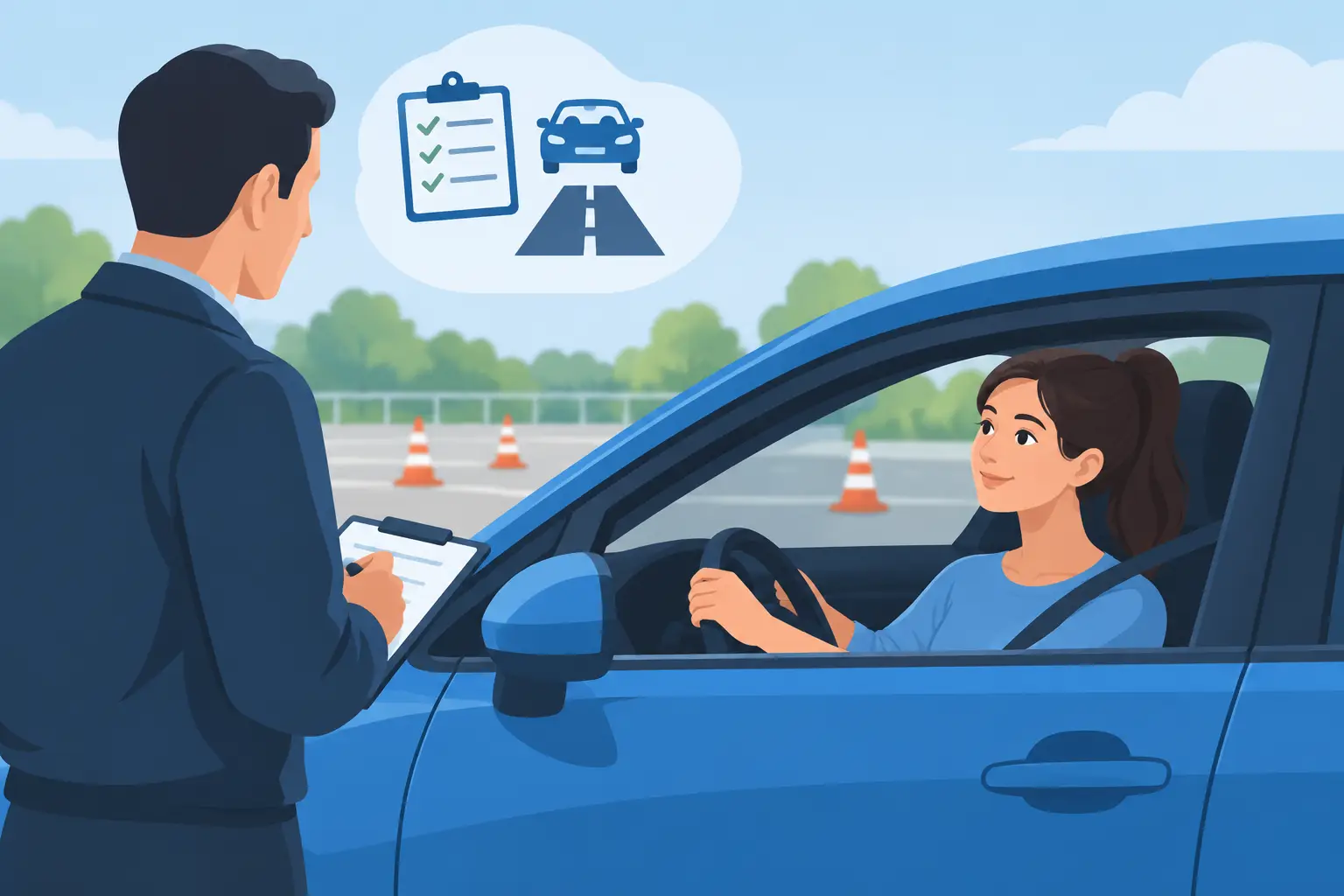
Your practical driving test is not the day to try to drive perfectly. It is your opportunity to show that you can make safe, sensible decisions and drive independently without your instructor guiding you through every situation.
The best way to prepare for DVSA driving test day is to turn that broad goal into a clear plan: understand what will happen, identify the areas that still need work and give yourself enough practice to feel settled behind the wheel.
A test pass is built through consistent driving experience, not squeezed into one intense final lesson. Whether you are learning to drive in Luton, Bedford, St Albans or elsewhere in Great Britain, the roads may be different, but you will be expected to demonstrate safe and independent driving.
Know what happens during the DVSA driving test
Understanding the test format can remove some of the uncertainty before test day.
The car driving test includes:
- An eyesight check.
- Two vehicle-safety questions.
- General driving ability.
- Independent driving.
- One reversing exercise.
You will normally drive for around 35 minutes.
During the test, you will encounter different road and traffic conditions. You will not be taken onto a motorway.
At the beginning, the examiner will ask you one “tell me” vehicle-safety question. This asks you to explain how you would carry out a particular safety check.
Later, while you are driving, you will be asked one “show me” question, where you demonstrate a safety task while maintaining control of the vehicle.
Getting one or both questions wrong normally results in one driving fault. However, losing control while carrying out the “show me” task can have more serious consequences.
Understand the independent driving section
Independent driving is an important part of the practical test.
You will drive independently for between 20 and 35 minutes, following:
- Directions from a sat nav.
- Traffic signs.
- Or a combination of both.
The examiner will tell you which method to follow and will set up the sat nav when one is being used. You cannot use your own sat nav for this part of the test.
Independent driving is not a navigation test.
If you take a wrong turning, you will not receive a fault simply because you went the wrong way. The examiner will help you return to the route where necessary.
What matters is how you drive.
Making a safe wrong turn is much better than suddenly changing lanes, braking sharply or making an unsafe turn because you are trying to follow the route perfectly.
During your final lessons, practise following a sat nav and traffic signs without relying on your instructor to prompt every decision.
The aim is for following directions to become part of normal driving rather than something that feels completely different on test day.
Know which manoeuvres you could be asked to do
During the test, the examiner will ask you to complete one reversing exercise.
This can be:
- Parallel parking at the side of the road.
- Parking in a bay — either driving in and reversing out or reversing in and driving out.
- Pulling up on the right-hand side of the road, reversing for around two car lengths and safely rejoining traffic.
You might also be asked to carry out an emergency stop.
When practising manoeuvres, do not become so focused on positioning the car perfectly that you stop observing what is happening around you.
Control and effective observation work together.
If another vehicle, cyclist or pedestrian approaches while you are manoeuvring, you need to recognise the developing situation and respond appropriately.
Taking your time and correcting your position safely is better than rushing simply because another road user is waiting.
Understand how driving faults are assessed
You do not need a fault-free drive to pass.
There are three categories of fault:
Driving fault — something that is not potentially dangerous, although repeatedly making the same mistake could eventually become serious.
Serious fault — something potentially dangerous.
Dangerous fault — something involving actual danger to you, the examiner, another road user or property.
You can pass with no more than 15 driving faults, provided you make no serious or dangerous faults.
This is important for managing your mindset during the test.
If something does not go exactly as planned, do not immediately decide that you have failed.
Concentrate on the next situation.
One mistake followed by another because you are still thinking about the first mistake can create a much bigger problem.
Build a preparation plan before test day
Avoid deciding that you are ready simply because you have completed a particular number of lessons.
Some learners need more driving lessons than others depending on their previous experience, confidence, private practice and how regularly they drive.
Instead, look at whether your driving is becoming consistently independent.
Ask your instructor for a clear assessment of the areas you can manage independently and the situations where you still need prompting.
Your final-stage lessons might include:
- Different types of junctions.
- Roundabouts.
- Higher-speed roads and dual carriageways where appropriate.
- Meeting and passing traffic.
- Appropriate speed selection.
- Independent driving.
- Manoeuvres.
- Moving off safely.
- Responding to road signs and markings.
- Situations where you currently hesitate or need assistance.
Do not spend every final lesson driving only on roads where you already feel comfortable.
The areas that make you hesitate are often the ones that deserve the most useful practice.
Practise the situations that make you hesitate
Most learners have particular situations that create more pressure than others.
You might be comfortable during normal driving but become uncertain at a busy roundabout.
Your parallel parking might be consistent until another vehicle appears behind you.
Or you may understand junctions but struggle to judge when it is safe to emerge when visibility is restricted.
Use your lessons to identify these situations and practise them systematically.
Instead of simply repeating a difficult junction, understand why it causes problems.
Are you approaching too quickly?
Are you choosing your lane too late?
Are your observations rushed?
Are you allowing the vehicle behind to pressure you into making a decision?
Breaking a difficult situation into smaller parts makes improvement much easier to measure.
Make independent driving feel normal
Do not wait until your final lesson to practise independent driving.
Ask your instructor to include sections where you follow sat-nav directions or road signs while making your own decisions.
Keep your attention primarily on the road rather than staring at the sat-nav screen.
Look well ahead for road signs, markings and changes in traffic conditions.
If you misunderstand a direction, continue driving safely.
Taking the wrong route does not automatically create a driving fault.
Trying to correct that mistake with an unsafe last-second manoeuvre could.
Independent driving should eventually feel like ordinary driving with a destination rather than a special test exercise.
Learn the area without memorising test routes
Driving around the area near your test centre can be useful.
It exposes you to local road layouts and situations such as complicated roundabouts, changing speed limits, narrow roads, bus lanes, multi-lane junctions or busy town-centre traffic.
But do not try to memorise a test route.
DVSA does not publish the routes used for driving tests.
Even if you have previously driven along the same road, traffic, pedestrians, roadworks and other conditions may be completely different on test day.
Use local practice to improve your ability to read unfamiliar situations, not to memorise a sequence of turns.
Use mock driving tests effectively
A mock test can be particularly useful as your real test approaches.
Ask your instructor to recreate the test environment as realistically as practical.
Instead of receiving constant coaching, drive for a period with limited assistance and receive feedback afterwards.
This can reveal something normal lessons sometimes hide: whether you can recognise and correct problems independently.
A useful mock test is not about obtaining a pretend pass or fail.
It should identify patterns.
Perhaps you consistently approach junctions too quickly.
Maybe your observations deteriorate during manoeuvres.
Or perhaps one small mistake causes you to lose concentration for several minutes.
Those patterns give you specific areas to improve before the real test.
Check the practical details before test day
Good driving preparation can be wasted if you arrive without the correct arrangements.
Check your test time and test centre in advance and make sure you bring your UK driving licence.
If you are using your instructor's car, confirm the arrangement and meeting time beforehand.
If you plan to use your own car, make sure it meets the DVSA requirements for driving tests.
Among other requirements, the car must be roadworthy, have no safety-related warning lights showing, have legal tyres, display L plates on the front and rear and have an additional interior rear-view mirror for the examiner.
The examiner also needs an appropriate passenger seatbelt and head restraint.
Check the complete current GOV.UK requirements before using your own vehicle rather than assuming that a car being legal for everyday driving automatically means it is suitable for a driving test.
Prepare for the eyesight check
The eyesight check happens at the beginning of your test.
For a vehicle with a new-style number plate, you must be able to read the number plate from 20 metres.
The required distance is 20.5 metres for an old-style number plate.
If you need glasses or contact lenses to meet the eyesight standard, make sure you wear them.
If you cannot pass the eyesight check, you will fail and the driving part of the test will not continue.
If you normally need corrective lenses for driving, preparing them should therefore be part of your test-day checklist.
Remember the 2026 driving-test booking rules
Driving-test booking rules changed during 2026.
You now need to book your own car driving test through GOV.UK. Your driving instructor cannot book the test on your behalf.
You are also responsible for managing your booking.
Before booking, speak to your instructor about whether you are likely to be ready and ask for their instructor reference number if you intend to use their car.
The number of changes you can make to an existing booking is also limited, so choose your test date carefully rather than booking a date you know is unrealistic and assuming it can repeatedly be moved later.
Your instructor can advise you about readiness, but responsibility for booking and managing the appointment belongs to you.
Manage test-day nerves rather than trying to eliminate them
Feeling nervous before a driving test is normal.
The goal does not need to be eliminating every sign of nerves. It is preventing those nerves from changing the way you normally drive.
The evening before your test, prepare what you need and confirm your appointment details.
Avoid spending the night trying to mentally rehearse every possible junction and manoeuvre.
On test day, give yourself enough time so you are not rushing.
During the drive, concentrate on the situation immediately in front of you.
You do not need to think about the remaining 30 minutes of the test.
Deal with the next mirror check, the next speed change, the next junction and the next decision.
If something goes wrong, recover safely and continue.
You may not know how the examiner has assessed an individual situation, so there is little benefit in deciding halfway through the test that you must have failed.
Safe driving does not mean rushed driving
Learners sometimes associate confidence with making decisions quickly.
They are not the same thing.
At a busy junction, taking enough time to establish that it is safe to proceed is better than accepting an unsuitable gap because another driver is waiting behind you.
At the same time, unnecessary hesitation can also become a problem if safe opportunities are repeatedly missed.
Test preparation should therefore help you develop appropriate judgement, rather than simply teaching you to wait longer or act faster.
Your instructor should gradually reduce the amount of help they provide so that these decisions become yours.
Use feedback to become independently test-ready
After each final-stage lesson, identify something that improved and something that still needs attention.
Specific feedback is much more useful than simply saying that you need “more confidence.”
For example:
- Check the left mirror before changing position around parked vehicles.
- Recognise speed-limit changes earlier.
- Approach closed junctions at a speed that allows enough time to observe.
- Maintain effective all-round observation during manoeuvres.
- Plan lane position earlier when approaching larger roundabouts.
These give you something measurable to practise during the next lesson.
Real Drive helps learners organise lessons, keep track of their progress and find instructors whose availability works with their learning schedule.
Let your preparation do the work
The purpose of your final lessons is not to teach you how to perform perfectly for an examiner.
It is to reach the point where safe driving decisions have become your normal way of driving.
By test day, you should be increasingly capable of observing independently, planning ahead, selecting appropriate speeds and positions, responding to other road users and recovering calmly when something does not go exactly as expected.
Give yourself permission to drive your own safe drive.
Stay observant, leave appropriate space, make considered decisions and concentrate on what is happening now rather than trying to predict the examiner's result.
Your test is one drive.
The skills you are demonstrating are the ones you will need every time you drive afterwards.
Keep learning