Driving Guide
How to Master Bay Parking: A Guide for Learner Drivers
Learn how to master bay parking with better positioning, low-speed control, effective observations and safe corrections for forward and reverse parking.
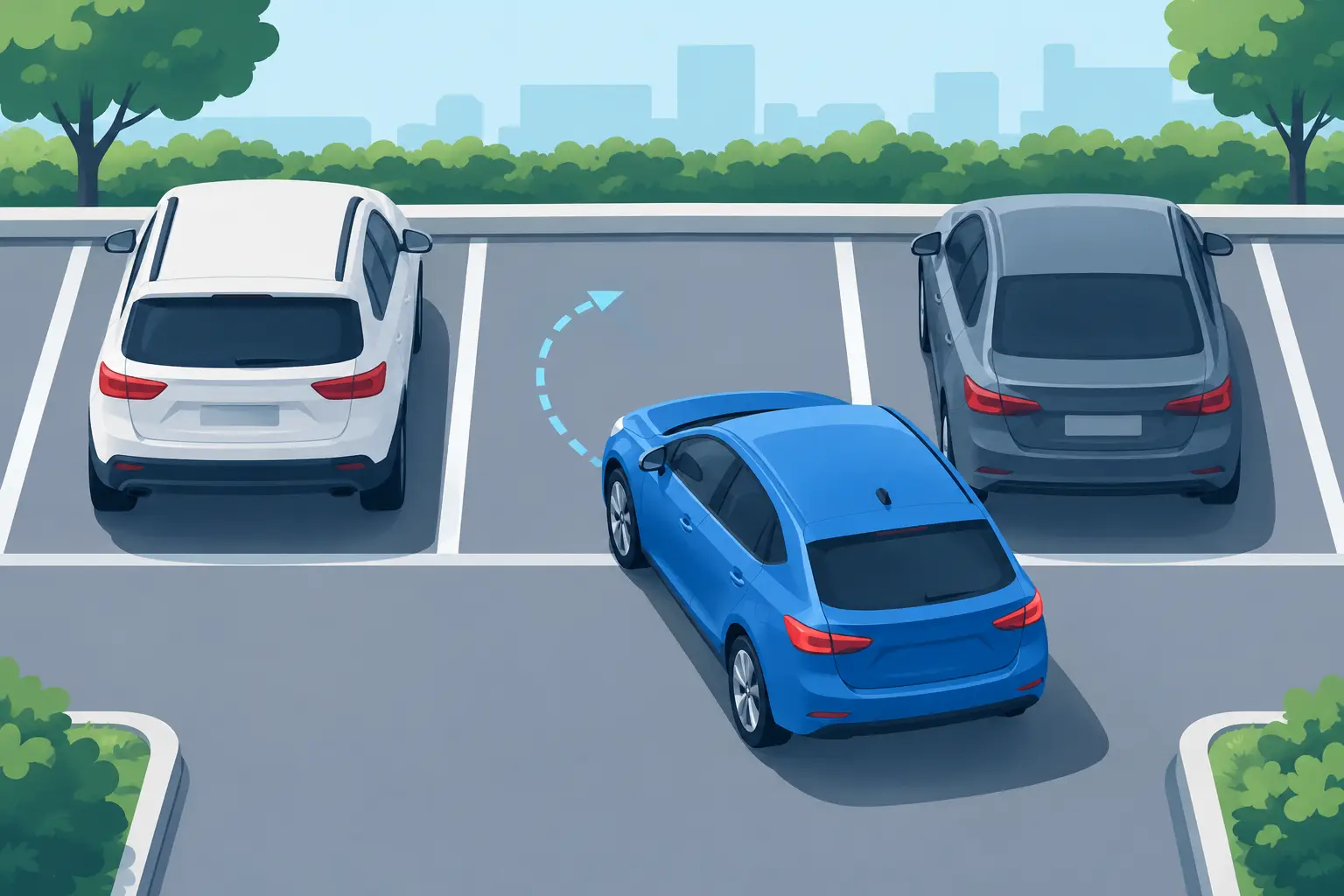
Bay parking can seem simple when you watch somebody else do it.
Then you sit in the driver's seat, look at two white lines in the mirrors and suddenly have to think about steering, speed, observations and where the back of the car is going.
Learning how to master bay parking is not about discovering one perfect reference point.
It is about understanding how your car moves at low speed, setting up with enough space, observing effectively and recognising when you need to make an adjustment.
Once those skills become familiar, bay parking becomes much less about memorising a routine and much more about controlling the car accurately.
What is bay parking?
Bay parking means positioning your vehicle within a marked parking space.
There are two main versions you should learn:
- Reversing into a parking bay and driving out.
- Driving forwards into a parking bay and reversing out.
Both are useful in everyday driving.
You may use them in:
- Supermarket car parks.
- Shopping centres.
- College or university car parks.
- Workplace car parks.
- Leisure centres.
- Public parking areas.
Bay parking can also form part of the practical driving test.
The examiner can ask you to park in a bay either by driving forwards into it and reversing out, or by reversing into it and driving out.
The exact manoeuvre you receive is not something you need to predict.
Learn how to manage both safely.
What is the examiner looking for?
Bay parking is not primarily a test of whether you know a particular reference point.
The important areas are control and observation.
You need to demonstrate that you can control the vehicle accurately at low speed while remaining aware of what is happening around you.
That includes:
- Choosing an appropriate position.
- Controlling your speed.
- Steering accurately.
- Observing effectively.
- Responding to pedestrians and other vehicles.
- Recognising when an adjustment is needed.
- Finishing appropriately within the parking bay.
A beautifully centred car does not compensate for poor observations.
Likewise, good observations do not mean positioning no longer matters.
You need both.
Start with good low-speed control
Bay parking becomes much easier when the car is moving slowly enough for you to think.
You do not need speed to complete the manoeuvre.
You need control.
In a manual car, your instructor may teach you to manage the vehicle using appropriate clutch, brake and accelerator control depending on the car and conditions.
If you are still developing those skills, see our guide to learning to drive a manual car.
In an automatic, you will normally use appropriate brake and accelerator control according to the vehicle and situation.
Whichever transmission you use, the principle is similar:
keep the vehicle slow enough that you have time to observe, judge the position and make controlled steering adjustments.
If the car begins moving faster than you can comfortably manage, regain appropriate control before continuing.
Observation comes before accuracy
A parking bay is not an isolated box.
There may be:
- Pedestrians.
- Children.
- Shopping trolleys.
- Cyclists.
- Other vehicles parking.
- Cars reversing.
- Vehicles approaching along the car park lane.
Before beginning the manoeuvre, establish what is happening around you.
Continue observing throughout.
Do not complete one observation at the beginning and then spend the rest of the manoeuvre staring into a mirror.
The situation can change while you are moving.
Someone who was nowhere near your car when you started could walk behind it seconds later.
Effective observation therefore continues for the entire manoeuvre.
How to reverse into a parking bay
Your instructor may teach a particular setup or reference point for the vehicle you use.
That is fine.
Different vehicles have different:
- Dimensions.
- Turning circles.
- Seating positions.
- Mirror positions.
- Visibility.
So there is no single reference point that works perfectly for every learner in every car.
Instead, understand what the setup is trying to achieve.
You need enough room for the vehicle to turn into the selected bay while remaining under control.
1. Choose a suitable bay
Identify the bay you intend to use.
Consider the available space and what is happening around it.
During the practical test, the examiner will give you the relevant instruction, but you still need to carry out the manoeuvre safely.
2. Position the car
Drive forward into an appropriate starting position.
Your instructor can help you establish a repeatable setup for your particular vehicle.
The objective is to leave enough room for the front and rear of the car to move through the turn.
3. Prepare to reverse
Select reverse when appropriate.
Before moving, carry out effective all-round observations.
Check for pedestrians, vehicles and anything else that could be affected by your manoeuvre.
4. Reverse slowly
Begin reversing under good control.
Use the method and steering point you have practised with your instructor.
But do not allow the reference point to take all your attention.
Continue observing around the vehicle.
5. Monitor the car's position
As the vehicle begins entering the bay, use your mirrors and observations to understand where it is travelling.
The bay lines can help you judge your position.
Ask yourself:
- Am I entering the intended bay?
- Am I too close to one side?
- Is the car beginning to straighten?
- Do I need to adjust?
You are no longer blindly following the original reference point.
You are responding to what the vehicle is actually doing.
6. Straighten the vehicle
As the car aligns with the bay, straighten the steering appropriately.
Continue reversing slowly while checking your position and surroundings.
7. Finish within the bay
Stop with the vehicle appropriately positioned within the marked bay.
Secure the vehicle as appropriate.
If the position is not satisfactory and it is safe to do so, consider whether an adjustment is needed rather than simply accepting a poor final position.
How to drive forwards into a parking bay
Forward bay parking uses many of the same skills.
You still need:
- Appropriate positioning.
- Low-speed control.
- Accurate steering.
- Effective observation.
The difference is that you initially drive forwards into the bay.
1. Choose the bay
Identify a suitable bay and assess the space around it.
2. Create enough turning space
Your starting position affects how easily the car can turn into the bay.
If you begin too close to the spaces, you may make the turn unnecessarily difficult.
Your instructor can show you an appropriate position for the vehicle you are driving.
3. Check the surroundings
Before changing your position or turning towards the bay, remain aware of pedestrians and other vehicles.
Car parks can change quickly.
4. Turn into the bay slowly
Use your practised steering method while maintaining low-speed control.
Look towards where you want the vehicle to go while also using your mirrors and observations to monitor its position.
5. Straighten and assess
As the vehicle enters the bay, straighten the steering appropriately.
Use the bay markings to judge whether the car is positioned correctly.
If necessary and safe, make an adjustment.
6. Secure the vehicle
Once you are satisfied with the position, stop and secure the car appropriately.
On the practical test, the forward bay parking exercise also involves reversing out of the bay.
That reversing stage is particularly important because your view may initially be restricted.
How to reverse safely out of a parking bay
Reversing out of a bay can sometimes require more observation than driving into it.
Vehicles parked beside you may restrict your view.
Before moving, check around the vehicle.
Then reverse slowly.
As more of the car emerges from the space, your view along the car park lane should improve.
Keep checking.
Do not assume the area remains clear simply because it was clear when you first selected reverse.
Look for:
- Pedestrians walking behind the car.
- Vehicles travelling along the lane.
- Cars reversing from other spaces.
- Children between parked vehicles.
- Cyclists.
- Shopping trolleys.
If another road user enters the area and could be affected by your manoeuvre, respond appropriately.
That may mean stopping and allowing them to pass.
Once it is safe again, carry out fresh observations before continuing.
Do not stare at one mirror
A common mistake when learning bay parking is becoming obsessed with the white lines.
You look into one door mirror and keep watching it because you want to know whether the wheel is crossing the line.
Meanwhile, the environment behind the car has changed.
Mirrors are useful for judging position.
But they do not replace effective all-round observation.
DVSA examiner guidance specifically assesses whether you remain aware of your surroundings during the manoeuvre.
Your attention needs to move appropriately between:
- The direction of travel.
- The surrounding area.
- Mirrors.
- Blind spots where relevant.
- The position of the vehicle.
The exact sequence can depend on the manoeuvre and situation.
What matters is that your observations are effective rather than simply performed as a memorised routine.
What if a pedestrian walks behind you?
Stop if necessary.
Do not continue reversing because you think the pedestrian should wait for you.
Car parks contain people who may not realise you are manoeuvring.
Someone might:
- Walk behind the vehicle.
- Step out between parked cars.
- Be looking at their phone.
- Push a trolley into your path.
- Be supervising a child.
Your job is to recognise what is happening and respond safely.
Once the situation is clear again, check around before continuing.
That demonstrates much better judgement than trying to complete the manoeuvre without interruption.
Reference points are useful, but they are not the skill
Reference points can be extremely useful while learning.
Your instructor might show you how a bay line appears in a particular window or mirror when the car reaches a useful steering position.
Use that information.
But understand its limitations.
The reference can change when:
- You change cars.
- Your seating position changes.
- The starting position changes.
- The bay dimensions differ.
- The road surface or parking area is different.
- Your approach angle changes.
So think of a reference point as a starting guide, not an automatic command.
Once you begin turning, monitor what the car is actually doing.
That is the skill you eventually need.
Learn what the steering does to the car
Bay parking becomes much easier when you understand the movement of the vehicle.
When reversing and steering, the rear of the vehicle moves towards the direction you are steering while the front swings in the opposite direction.
That front swing matters.
You may be concentrating on getting the rear of the car between the bay lines while forgetting that the front of the vehicle is moving closer to another car or obstacle.
Keep awareness of the whole vehicle.
Your instructor can help you practise this initially in an open area where you can clearly see how different amounts of steering change the car's path.
Understanding the movement is more transferable than memorising one steering point.
Can you correct a bay park on the driving test?
Yes, making an adjustment does not automatically mean you have failed the manoeuvre.
If you recognise that the vehicle is not positioned correctly, a safe and controlled correction can demonstrate useful judgement.
For example, you may need to move forwards and realign before reversing again.
The important things are to:
- Maintain control.
- Observe effectively before and during the adjustment.
- Avoid creating danger.
- Finish in an acceptable position.
However, repeated or excessive repositioning because the manoeuvre has been significantly misjudged can affect the assessment.
The aim is therefore not:
"Never correct."
It is:
"Recognise problems early and make an appropriate correction when necessary."
Do you fail for touching a bay line?
Do not approach bay parking with the idea that touching a white line automatically determines the entire test result.
The examiner assesses the manoeuvre as a whole, including your control, observations and final position.
Current DVSA examiner guidance distinguishes between minor positioning issues and more significant problems.
What matters is that you demonstrate appropriate control and finish with the vehicle suitably within the parking bay.
If you recognise that your position is poor, correcting it safely can be better than ignoring it.
Concentrate on performing the manoeuvre properly rather than trying to calculate whether every small movement represents a particular type of fault.
Common bay parking mistake: turning too early
If you turn too early, the car may enter the bay at an unsuitable angle or become too close to one side.
Do not automatically add more steering in an attempt to rescue the manoeuvre.
Slow down or stop where appropriate.
Look at the vehicle's position.
Then decide whether you can correct it safely.
Learning to recognise why the car ended up there is more useful than simply repeating the manoeuvre from the beginning.
Common bay parking mistake: turning too late
Turning too late can create the opposite problem.
The vehicle may travel too far before beginning the turn and approach the other side of the bay at an unsuitable angle.
Again, avoid panicking.
Control the vehicle.
Observe.
Assess the position.
Correct where appropriate.
As your judgement improves, you should begin recognising the problem earlier.
Common bay parking mistake: moving too quickly
Speed removes thinking time.
If the car moves faster than you can comfortably observe and steer, the manoeuvre becomes much harder.
Good low-speed control allows you to:
- Notice positioning errors earlier.
- Observe pedestrians.
- Respond to moving vehicles.
- Adjust steering smoothly.
- Stop promptly when necessary.
There is no advantage in completing the manoeuvre quickly.
Control matters more than speed.
Common bay parking mistake: forgetting the front of the car
When reversing, learners often become completely focused on the rear.
But the front of the car swings as you steer.
That can bring it closer to:
- Another parked vehicle.
- A wall.
- A post.
- A kerb.
- Another obstacle.
Your observations therefore need to include the space around the whole vehicle.
This becomes particularly important in tighter car parks.
Common bay parking mistake: trying to memorise every movement
A learner might try to remember:
"Drive to this line, turn exactly one full turn, wait until that point appears, then straighten."
That can work during practice in one particular car.
But if the starting position is slightly different, the result may also be different.
Instead, combine your reference points with judgement.
Understand:
- Why you are starting from that position.
- Why you are steering at that point.
- What you expect the car to do.
- What the bay lines should look like as you enter.
- How to recognise when an adjustment is needed.
That makes the method much more adaptable.
What about dry steering?
You may sometimes hear advice that you should never turn the steering wheel while the vehicle is stationary.
Turning the steering while stationary can increase tyre and steering-system wear compared with steering while the vehicle is moving.
In normal manoeuvring, developing smooth coordination between movement and steering is useful.
But during a driving lesson or test, safety and control come first.
Do not continue moving simply because you believe stopping while steering is automatically forbidden.
Follow the technique appropriate to the vehicle and situation, and use your instructor's guidance to develop smooth low-speed steering.
Practise in different parking situations
Once you understand the basic manoeuvre, avoid practising only in exactly the same bay from exactly the same starting position.
Real car parks vary.
Practise where appropriate in:
- Different bay sizes.
- Bays on the left.
- Bays on the right.
- Different car parks.
- Different lighting conditions.
- Slightly busier environments as your ability improves.
DVSA's own guidance for learners who need to improve bay parking recommends practising in different car parks.
The objective is to develop judgement that works when the environment changes.
Start somewhere quiet
You do not need to begin in the busiest supermarket car park on Saturday afternoon.
A quieter suitable car park gives you more opportunity to understand how the car moves without unnecessary pressure.
Make sure you are allowed to practise there and that the learner, supervising driver, vehicle and insurance arrangements meet the relevant requirements.
As your control and observations improve, you can practise in more realistic environments.
The challenge should increase gradually.
Include bay parking in your progress tracking
Do not record bay parking simply as:
"Done."
Break the skill down.
For example:
Control: Can I keep the vehicle at an appropriate low speed?
Setup: Can I choose a suitable starting position?
Steering: Do I understand how the car moves into the bay?
Observation: Am I checking effectively throughout?
Accuracy: Can I finish appropriately within the bay?
Correction: Can I recognise and safely correct a poor position?
That gives you a much clearer idea of what actually needs improvement.
Our driving lesson progress tracker explains how to track individual skills as your driving becomes more independent.
Bay parking on the practical driving test
Bay parking is one of the manoeuvres you may be asked to complete during the practical car test.
You may be asked to:
- Reverse into a parking bay and drive out.
- Drive forwards into a parking bay and reverse out.
Alternatively, the examiner may select another reversing exercise instead.
You do not need to know in advance which one you will receive.
Prepare for all of the manoeuvres you have been taught.
During bay parking, concentrate on the same things you should use in everyday driving:
- Control.
- Observation.
- Accuracy.
- Awareness of other road users.
- Safe judgement.
Do not rush because you are being watched.
And do not assume that making a small correction means the test is over.
Keep driving safely unless the examiner tells you otherwise.
Our guide to preparing for your DVSA driving test explains the wider test and how to prepare for it.
How Real Drive can support your learning
Bay parking is only one part of learning to drive.
You also need to develop observations, junctions, roundabouts, planning, speed management, independent driving and other skills.
Real Drive helps learners keep that wider journey organised by making it easier to find verified instructors, manage lessons and maintain visibility over progress.
A structured driving tuition plan can help you understand how individual skills such as bay parking fit into becoming a safe, independent driver.
Master the method, not just the reference point
Reference points can help you learn bay parking.
But they should eventually support your judgement rather than replace it.
Know why you are starting from a particular position.
Keep the car under good low-speed control.
Observe throughout the manoeuvre.
Watch what the vehicle is actually doing.
Recognise when the position is not developing as expected.
And make a safe adjustment when necessary.
With practice, you should rely less on trying to reproduce one perfect sequence and more on understanding the space around the vehicle.
That is when bay parking starts becoming an everyday driving skill rather than a manoeuvre you have memorised simply for the test.
Keep learning