Driving Guide
How to Learn to Drive Manual: A Step-by-Step Guide
Learn how to drive a manual car step by step, from clutch control and gear changes to junctions, hill starts, private practice and driving-test preparation.
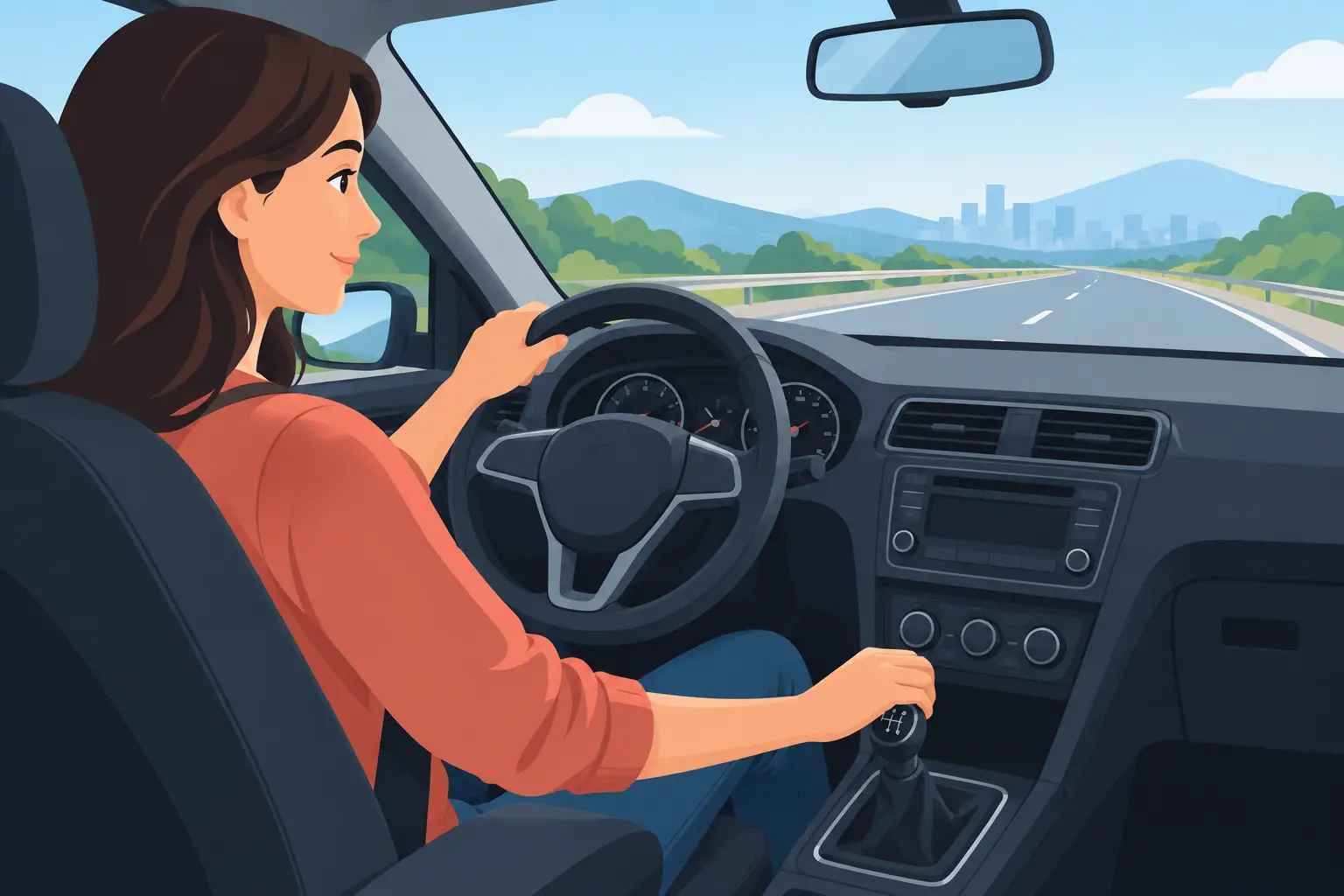
The first time a manual car stalls, it can feel as though everyone on the road has noticed. They probably have not. Stalling is a normal part of learning how to drive a manual car, and learning to recover calmly can teach you valuable lessons about clutch control, timing and staying composed.
Passing your practical test in a manual car gives you the flexibility to drive both manual and automatic cars covered by your licence. But before thinking about the test, the goal is to make the basic controls feel natural enough that you can concentrate on what really matters: observing, planning and making safe decisions.
The quickest route is not necessarily rushing through lessons. It is following a clear learning plan with an instructor you have checked and feel comfortable with, then practising each skill until you can perform it consistently.
Start with the right manual driving setup
Before moving the car, become familiar with the controls and your driving position.
In a typical manual car, your left foot operates the clutch while your right foot operates the brake and accelerator. The gear lever allows you to select the appropriate gear for the situation.
Your instructor should help you adjust the seat, steering position, head restraint and mirrors before you start driving.
You need to be able to press the clutch pedal fully without stretching while maintaining a comfortable driving position. Your arms should also have enough movement to steer effectively without you sitting unnecessarily close to the wheel.
A comfortable position is not just about convenience. It makes smooth pedal control, steering and effective observation easier.
Before your first attempts at moving away, it can help to become familiar with the gear positions while the car is stationary and secured.
Many manual cars use an H-pattern gear layout, but the number and position of gears — particularly reverse — can vary between vehicles. Check the markings on the gear lever and follow your instructor's guidance rather than assuming every manual car works exactly the same way.
Learn clutch control before worrying about speed
Clutch control is one of the skills new manual drivers often worry about most.
It also becomes much easier with patient, repeated practice.
One important concept is the biting point. This is the point as you gradually raise the clutch pedal where the clutch begins transmitting power from the engine towards the wheels.
Your instructor may introduce this on a suitable quiet road or practice area.
Typically, you will learn how to select first gear, prepare the car and gradually bring the clutch towards the biting point while using the accelerator as appropriate for the vehicle and situation.
You may notice a slight change in engine sound or feel the car begin to respond.
The exact technique can vary between vehicles. Different petrol, diesel, hybrid-assisted and other manual cars can respond differently, so learn the characteristics of the car you are actually driving rather than trying to memorise one exact pedal position.
If you stall, concentrate on making the situation safe and restarting correctly rather than worrying about the driver behind you.
Follow the procedure your instructor has taught you, regain control of the vehicle, complete your observations again where necessary and move away when it is safe.
Rushing because another road user is waiting is more likely to create another mistake.
A smooth move-off becomes a routine
When you are ready to move away, use the routine your instructor teaches you.
Broadly, this involves preparing the vehicle, making effective observations, signalling when necessary and moving away under control when it is safe.
Early in your training, these may feel like separate steps.
With practice, they begin to work together naturally.
Stopping also requires coordination. You need to observe what is happening behind and around you, reduce speed appropriately, maintain control of the vehicle and use the clutch when necessary to prevent the engine from stalling.
Your instructor will help you understand when to use each control rather than simply teaching you a sequence to perform without considering the situation.
The aim is eventually to understand why you are doing something, not just remember a routine.
How to learn to drive manual through gear changes
Gear changing often feels complicated at first because you are trying to coordinate your feet and hand while still watching the road.
It becomes much easier with repetition.
For a typical upward gear change, you will ease off the accelerator, press the clutch, select the appropriate gear, release the clutch smoothly and return to the accelerator as required.
Your instructor will help you develop the timing so the car remains stable and smooth.
Avoid staring at the gear lever or rev counter.
As your experience grows, you will learn to recognise when a gear change is appropriate from the sound and response of the vehicle, your speed and what is happening ahead.
Changing down requires planning too.
A lower gear may be appropriate as you reduce speed for situations such as junctions, bends, roundabouts or hills. The appropriate gear depends on the speed of the vehicle, the road conditions and what you intend to do next.
This is why gears should not be treated as rigid speed targets.
The same gear may be useful at different speeds depending on the vehicle and circumstances.
Your instructor should also help you avoid unnecessary coasting, such as keeping the clutch depressed or travelling in neutral when doing so reduces your control of the vehicle.
The objective is not to change gear as often as possible. It is to use a gear that gives you appropriate control for the situation.
Build confidence at junctions and roundabouts
Manual driving becomes more demanding when observation, planning, steering, braking and gear selection all need your attention at approximately the same time.
This is where structured progression is valuable.
Rather than moving immediately onto complex roundabouts, a learner will normally develop the underlying skills on more suitable roads first.
At junctions, begin planning early.
Use your mirrors, adjust your speed appropriately and select a suitable gear while assessing the junction and what you can see.
Where visibility is restricted, you may need to move forward carefully until you can see enough to make a safe decision. Your instructor will teach you how to do this while maintaining appropriate control of the vehicle.
Do not allow pressure from a vehicle behind to make the decision for you.
The important question is whether you have enough information and space to proceed safely.
Roundabouts use the same principles.
Plan the approach, adjust your speed, select an appropriate gear and make effective observations for the particular roundabout.
The goal is not to perform a fast gear change immediately before entering. It is to arrive with enough time and control to make a safe decision.
And if you take a wrong exit or miss the one you intended, continue safely.
A navigation mistake is usually much less important than making an unsafe last-second correction.
Practise hill starts progressively
Hill starts can initially feel difficult because you need to coordinate the controls while preventing the car from rolling unexpectedly.
Your instructor should introduce them progressively.
Depending on the vehicle and technique being taught, this can involve securing the car, preparing the accelerator and clutch, finding an appropriate biting point and then moving away smoothly when it is safe.
Modern vehicles may also have features such as hill-start assistance.
These can be useful, but you still need to understand how your particular car responds and how to maintain control when moving away on a gradient.
Do not worry if hill starts take repeated attempts.
The objective is not simply to avoid rolling backwards once. It is to develop a repeatable technique that you can use confidently in different situations.
Make private practice between lessons useful
Private practice can be extremely useful when it reinforces what you are learning professionally.
However, make sure you meet the legal requirements before practising.
In Great Britain, a learner must be supervised by someone who meets the applicable age and licence requirements, and the learner must be properly insured to drive the vehicle. The vehicle must also meet the relevant legal requirements for learner driving.
If you are unsure whether your proposed supervisor, insurance or vehicle meets the rules, check the current GOV.UK learner-driving requirements before practising.
Once those arrangements are in place, give each practice session a purpose.
Instead of simply driving around for an hour, you could concentrate on a small number of skills such as:
- Smooth moving off and stopping.
- First-to-second and second-to-third gear changes.
- Quiet junctions.
- Meeting and passing traffic.
- Hill starts.
- Planning your approach to roundabouts.
Focused repetition can make it easier to recognise improvement.
Private practice should also support rather than undermine your professional lessons. If your supervising driver gives advice that conflicts with what your instructor has taught you, discuss it with your instructor rather than trying to follow two different methods simultaneously.
After a lesson or practice session, make a short note of what improved, what still feels difficult and what you want to work on next.
Progress is rarely perfectly linear.
A difficult lesson after several good ones does not mean you have gone backwards. It may simply mean you have moved onto a more demanding skill or road environment.
Real Drive helps learners compare verified local instructors, find lesson availability that works around other commitments and keep their learning progress organised in one place.
Prepare for the practical test without memorising routes
The practical driving test is designed to assess whether you can drive safely and independently, rather than whether you can reproduce a memorised test route.
As your driving develops, your instructor should gradually introduce more independent decision-making and test-relevant situations.
That includes maintaining appropriate observations, dealing with different types of traffic, controlling the vehicle, choosing appropriate speeds and demonstrating the required manoeuvring skills.
Manual learners sometimes worry that stalling automatically means failing the driving test.
It does not necessarily.
What matters is the circumstances and how the situation is handled. A stall could result in a driving fault, and a more serious situation could be assessed differently if it creates significant risk or demonstrates a serious loss of control.
If you stall, concentrate on recovering safely rather than assuming the test is already over.
The same principle applies if you take a wrong turn.
Continue safely and follow the examiner's directions when possible. Do not make a sudden or unsafe manoeuvre simply to return to the intended route.
Safe decision-making matters more than driving perfectly.
How long does it take to learn manual driving?
There is no single number that applies to every learner.
The time needed depends on factors such as previous experience, lesson frequency, private practice, confidence and how quickly you develop consistent independent decision-making.
Manual learners also need time to make clutch and gear operation sufficiently automatic that those controls do not take excessive attention away from the road.
Booking lessons at a pace you can maintain can be more useful than taking several lessons close together and then having a long break.
Regular practice gives you an opportunity to reinforce skills before they become unfamiliar again.
The aim should not be to reach the test in the fewest possible hours.
It should be to reach a point where you can repeatedly demonstrate safe, independent driving across a range of situations.
Choose manual lessons that fit the way you learn
Learning manual driving requires repetition, patience and effective feedback.
It helps to choose an instructor you can communicate with comfortably.
You should be able to ask why something went wrong, request more practice on a difficult skill and talk openly about areas where you lack confidence.
A good instructor should adapt the lesson to your progress while continuing to challenge you appropriately.
If clutch control is taking longer than expected, that does not mean you cannot learn manual driving. If roundabouts feel overwhelming, breaking the task into observation, approach speed, positioning and decision-making can make the problem easier to understand.
Manual driving is learned one controlled decision at a time.
Give yourself permission to be inexperienced at the beginning and practise the awkward parts instead of avoiding them.
Notice the small milestones: your first smooth move-off, the first hill start that feels controlled, the first busy junction where you plan everything early, and eventually the journey where you realise you changed gears without consciously thinking about it.
That is when manual driving begins to stop feeling like a collection of separate controls and starts feeling like driving.
Keep learning